
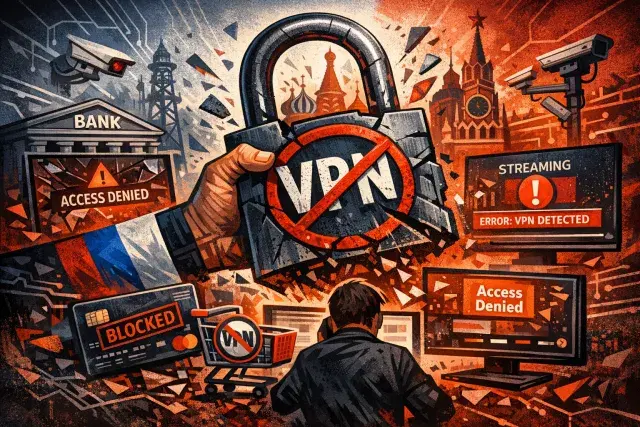

Russian authorities have dramatically widened their campaign against virtual private networks, with major domestic services — including banks, online retailers, and streaming platforms — now actively denying access to users detected as connecting through VPNs. The escalation, confirmed by both state and independent media on Wednesday, marks a significant new phase in Moscow's tightening grip on internet freedom, extending restrictions beyond blocked foreign platforms to the everyday digital infrastructure Russians rely on.
What Changed and How It Works
VPNs function by routing a user's internet traffic through encrypted tunnels to servers in other locations, masking both the user's identity and the websites they visit. For millions of Russians, they became essential tools after Moscow imposed sweeping online censorship following the launch of its full-scale military offensive against Ukraine in February 2022. Critical news outlets, Western social media platforms, and messaging services were rapidly blocked, and VPN adoption surged in response.
Until now, the primary enforcement mechanism involved telecoms operators attempting to throttle or disrupt VPN traffic at the network level — an imperfect approach, since many VPN protocols are designed to disguise themselves as ordinary traffic. The new measures represent a different strategy: compelling the services themselves to detect and refuse VPN connections. AFP journalists in Moscow confirmed that attempting to access major online retailers Ozon and Wildberries through a VPN produced explicit error messages demanding users disable their VPN before proceeding.
According to TASS, the state news agency, the Russian government had set an April 15 deadline for telecoms operators and major online services to implement VPN-user blocking. The result is that Russians who rely on VPNs — whether for privacy, security, or access to censored content — now face a stark choice: disconnect from the VPN to use domestic services, or lose access to banking, shopping, and entertainment platforms.
The Kremlin's Careful Ambiguity
Kremlin spokesman Dmitry Peskov offered a carefully worded non-denial when asked about the restrictions. "There are currently no bans on VPNs, and no criminal liability for using them," he told AFP. "I have no information to the contrary, or about any plans about that." The statement is technically accurate in a narrow sense — Russia has not formally criminalized VPN use by individuals. But it sidesteps the reality that the government is systematically making VPNs functionally unusable within Russia's domestic digital ecosystem.
This approach mirrors a broader pattern in Russian internet governance: avoiding explicit legal prohibitions that might provoke public backlash while quietly rendering circumvention tools impractical through technical and administrative pressure. The effect is the same as a ban, but without the political cost of declaring one.
A Broader Campaign to Control Digital Life
The VPN crackdown does not exist in isolation. Russia's internet watchdog, Roskomnadzor, has for months been throttling the country's two most widely used messaging platforms — Telegram and WhatsApp. The apparent objective is to push users toward Max, a state-backed super-app modeled on China's WeChat. Max is unencrypted, a characteristic that privacy advocates and critics say makes it inherently susceptible to government surveillance. The parallels with China's approach to internet control are neither accidental nor subtle.
Taken together, these measures sketch the outline of a digital environment in which Russians can communicate and transact online only through channels visible to the state. Foreign platforms are blocked. VPNs that might circumvent those blocks are rendered incompatible with essential domestic services. And the messaging apps that remain functional are either state-controlled or degraded to the point of frustration.
What This Means Going Forward
The practical consequences for ordinary Russians are significant. Many professionals, businesses with international operations, and journalists rely on VPNs not just to access banned content but for legitimate security purposes — protecting sensitive communications, securing financial transactions, and connecting to corporate networks abroad. Forcing these users to choose between digital security and access to basic domestic services imposes a real cost.
For the Russian government, the calculus appears straightforward: the political risks of an informed, digitally connected population outweigh the economic friction caused by restricting internet tools. Since 2022, Moscow has systematically eradicated public opposition to the war and dismantled independent media. Cutting off the digital workarounds that survived those earlier purges is a logical next step in that process. The internet Russians can access is shrinking, and the walls around it are growing higher.
