
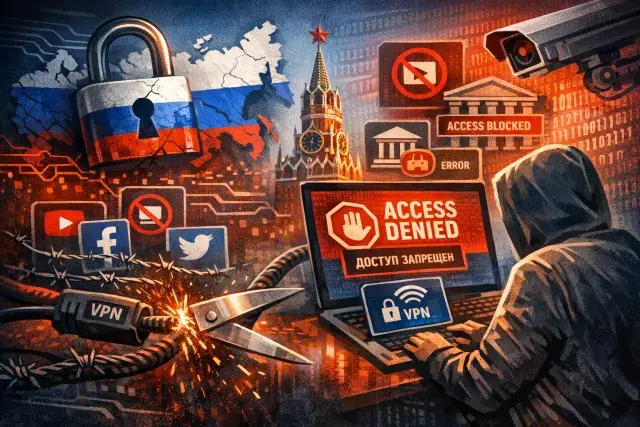

Major Russian online platforms have started denying access to users connected through virtual private networks, extending the state’s campaign against tools that help people bypass censorship. The shift appears to follow a reported government deadline for large digital services to restrict VPN use, and it matters because VPNs have become one of the few practical ways many Russians reach blocked media, apps and foreign platforms.
A broader push is moving from state filters to private platforms
The immediate change is visible on mainstream services. The Moscow Times confirmed that Ozon and Kinopoisk were showing denial messages to some visitors using VPNs, while reports also pointed to disruptions in banking and ride-hailing apps. That marks an important escalation: internet controls are no longer limited to state regulators blocking sites at the network level, but are increasingly reinforced by ordinary commercial services that Russians use every day.
The companies have not publicly explained the restrictions. Even so, the timing aligns with official rhetoric. Digital Development Minister Maksut Shadayev said his ministry had been tasked with reducing VPN use, linking the policy to disputes with foreign technology companies over compliance with Russian law. In practice, this means the state is trying to make circumvention harder not only by blocking VPN services themselves, but by making VPN connections less useful when accessing domestic platforms.
Why VPNs matter in Russia’s current internet environment
VPNs encrypt traffic and route it through another server, masking a user’s apparent location and helping evade local filtering. In Russia, their role expanded sharply after authorities blocked Western social platforms and many independent news outlets following the full-scale invasion of Ukraine in 2022. For many users, a VPN is not a niche privacy tool. It is a basic method of reaching information that would otherwise be inaccessible.
Blocking VPN users at the website or app level can be done in several ways, including rejecting traffic from known VPN server addresses or treating such connections as suspicious. That approach is imperfect. Some services may still work, others may fail intermittently, and access can vary by region or by the specific VPN provider a person is using. That helps explain why some Russian platforms remained reachable with a VPN switched on, and why Telegram access appears inconsistent across the country.
The practical effect is a more fragmented and less reliable internet
For users, the result is confusion as much as prohibition. Someone may need a VPN to open one service, then disable it to pay for goods, order a taxi or watch a film on another. This kind of friction changes behavior over time. A tool that becomes cumbersome or breaks routine digital services is less likely to be kept on constantly, which serves the state’s larger aim of reducing circumvention without formally criminalizing it.
The policy also fits a wider pattern. Russia has spent years building a more controllable domestic internet, with legal, technical and administrative tools that allow officials to slow platforms, block content and pressure companies into compliance. Recent mobile internet disruptions and slowdowns affecting WhatsApp and Telegram point to a model of control that is becoming more flexible and less transparent. Users often see only symptoms: failed logins, stalled messages, unexplained outages.
What comes next
The Kremlin says VPN use itself is not illegal and denies knowledge of plans to punish it. But legality is only one part of the issue. A service does not need to be banned outright to become difficult enough that many people stop relying on it. If more major Russian platforms adopt VPN detection and blocking, the country’s internet will move closer to a system where access depends not just on what the state censors directly, but on what domestic companies decide or are told to restrict.
That would leave Russians with a narrower, more domestically bounded online space. The significance goes beyond convenience. When access tools are weakened, the range of reachable news, discussion and communication narrows with them.
