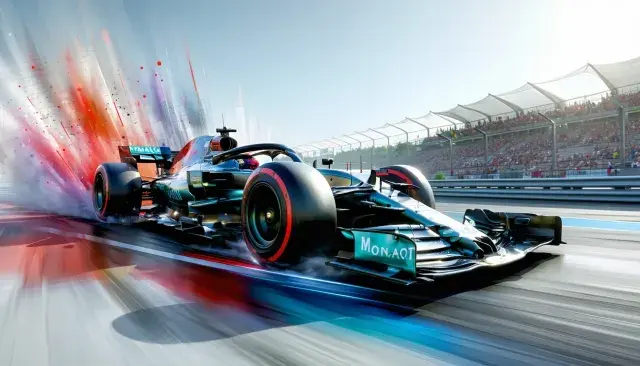

On June 7th, 2026, seventy-eight laps of a 3.337-kilometre circuit through the Principality of Monaco will determine one of the most coveted results in motorsport. The streets close, the barriers go up, and the event that has defined Formula 1's identity since 1929 runs again - tighter, louder, and more unforgiving than any other venue on the calendar. Here is everything you need to know, and how to watch it without spending a penny.
Why Monaco Remains Unlike Any Other Circuit on the Calendar
Most racing venues are purpose-built. They offer run-off areas, gravel traps, tyre barriers positioned with care. Monaco offers none of that. The circuit passes through the actual streets of a functioning city-state: past apartment buildings, through a tunnel, around a harbour. The barriers are stone and Armco, and they are close enough to touch at speed.
The first corner, Sainte-Dévote, arrives after barely four hundred metres of acceleration. It is a tight right-hander compressed between two stone walls, and drivers reach it late on the brakes, trusting grip and instinct before doing it again seventy-seven more times. The tunnel section plunges drivers from full Mediterranean sunlight into sudden darkness at speeds approaching 280 km/h, with no meaningful margin if something goes wrong. The swimming pool chicane demands a precision so exact that a fraction of a second's hesitation ends the afternoon against concrete.
What makes Monaco genuinely different from every other venue is not the danger alone. It is the impossibility of recovery. Overtaking on the race itself is nearly impossible. The circuit is barely wide enough for two cars at most points. Starting position on the grid is, at Monaco more than anywhere else, effectively decisive. Qualifying on Saturday carries a weight that makes it closer to the race result than the race itself. This is why drivers speak about Monaco in terms of feel and rhythm rather than lap times and sector splits - the standard language of the discipline simply does not capture what the circuit demands.
The 2026 Grid and the Drivers Who Will Define This Race
Charles Leclerc arrives at Monaco 2026 carrying both the weight and the advantage of familiarity. He grew up in the Principality. He watched the event from the barriers as a child, memorised every apex and camber change, every shadow cast by the buildings across the tarmac on a June afternoon. He has qualified on pole here and he has won here. For Leclerc, Monaco is a recurring conversation with his own history, and that history is a genuine asset on a circuit where local knowledge translates directly into tenths of a second.
Kimi Antonelli brings the momentum of a strong season and the hunger of a driver who has not yet taken a result on these streets. George Russell will be methodical and controlled, extracting the maximum from clean laps and positioning. Lando Norris will look for the gap that does not exist and occasionally find it anyway - a quality that defines his approach and periodically produces results that confound the constraints of the track.
Rain changes everything. A single shower redistributes positions with a speed that no strategy call can replicate. Monaco in wet conditions becomes a different discipline entirely - one where instinct overrides data, where the bravest decision rather than the fastest machinery decides the outcome. The weather forecast for early June in the Principality is never a settled matter, and meteorological uncertainty adds a layer of genuine unpredictability to an event that otherwise rewards the known quantity.
How to Watch the Monaco Grand Prix 2026 for Free
Three public broadcasters are showing the Monaco Grand Prix live and without charge in 2026. Each offers a meaningfully different experience.
- RTBF Auvio (Belgium) - Stable HD stream, experienced commentary team, no mid-race advertising interruptions. The most reliable of the three options.
- RTS Sport (Switzerland) - Full race broadcast, no account registration required, clean interface.
- ServusTV (Austria) - Sharp production with active camerawork that follows the battles rather than defaulting to the leader.
The practical obstacle is geoblocking. All three services are restricted to their home countries by IP address. An international connection returns a blank screen. A VPN resolves this in under a minute. NordVPN, one of the most widely used services in this category, allows you to connect through a Belgian, Swiss, or Austrian server - visit https://www.rtbf.be/ after connecting to a Belgian server - and the stream opens as if you were based locally. The service covers ten devices simultaneously, removes ads and trackers by default, and includes a 30-day money-back guarantee, which means you can watch Monaco, the Spanish Grand Prix, and the Austrian round before any financial commitment is required.
Race Weekend Schedule and Key Facts
- Race date: Sunday, June 7th, 2026 - start time 4:00 PM local
- Practice and qualifying: June 4th through June 6th
- Circuit length: 3.337 km
- Race distance: 78 laps, up to 19 corners, one DRS zone
- Location: Circuit de Monaco, Principality of Monaco
The DRS zone - the single straight long enough to allow the drag-reduction system to function - underlines the structural problem of overtaking here. One zone, one brief window, and the defending driver is almost always able to cover it. Strategy and starting position therefore carry more weight at Monaco than at any other venue, and the Saturday qualifying session deserves as much attention as the race itself.