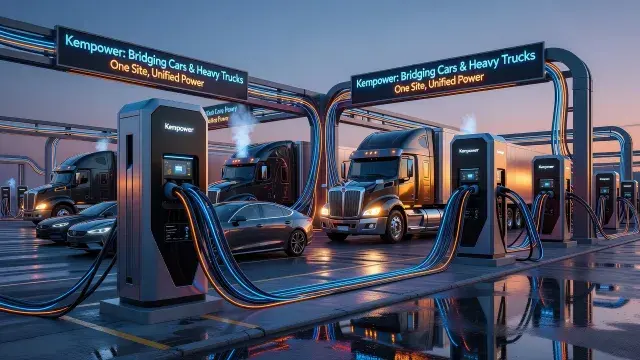
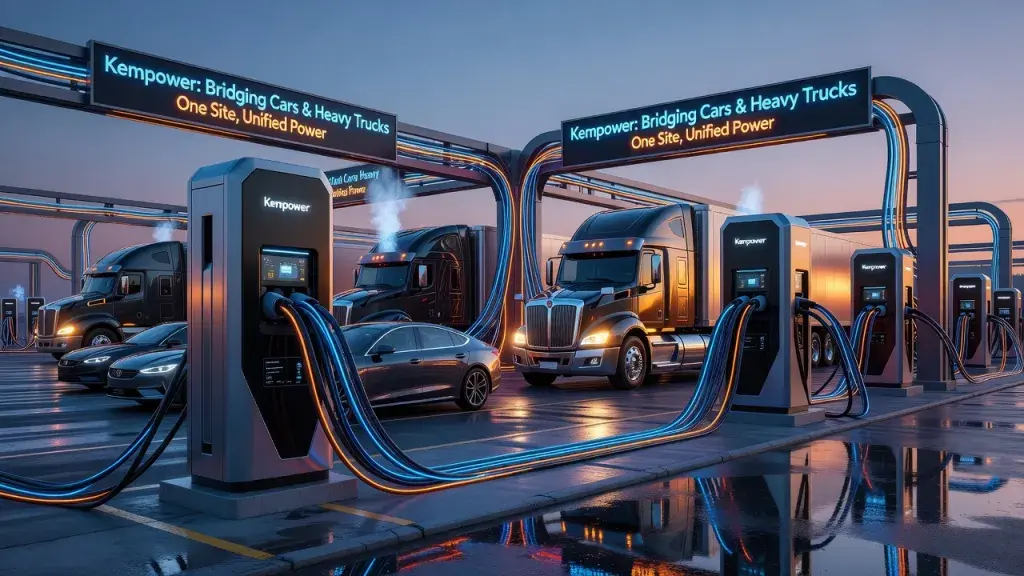
A single charging bay that can fuel a family sedan and a fully loaded semi truck without separate equipment is no longer a concept on a slide deck. Kempower has introduced the Mega Satellite Flex, a dispenser capable of delivering up to 560 kW through the established CCS standard or up to 1.2 MW through the emerging Megawatt Charging System, making it the company's first unit to support both standards in one physical package.
The timing reflects a real fork in the road for charging infrastructure. CCS remains the dominant plug for passenger electric vehicles across North America and Europe, while MCS is being built specifically for the far higher power demands of electric trucks and buses, which need to recharge large battery packs in a limited rest period. Rather than forcing site owners to choose one standard and gamble on the other, Kempower's dual-format approach lets operators serve both categories of vehicle from day one - much the way a household might lock in flexibility by choosing a discounted multi-year plan instead of committing to a single rigid option upfront. That flexibility matters because charging hubs, like most infrastructure investments, carry long payback horizons, and equipment that can adapt to shifting vehicle mixes reduces the risk of stranded assets.
Why the Dual Standard Matters
Heavy-duty electrification has lagged passenger EV adoption partly because trucking cannot tolerate long downtime. A delivery fleet idling for hours to recharge erodes the entire economic case for going electric. MCS was developed precisely to solve that problem, targeting charge rates far beyond what CCS was ever engineered to handle. But MCS-only sites make little sense yet, since truck adoption is still ramping up and passenger EV traffic remains the larger, steadier revenue source for most charging locations. A charger that reads either plug type removes that bet entirely.
The Mega Satellite Flex also supports 800-volt vehicle architectures, an area where newer EV models are increasingly capable of accepting faster charge rates than older 400-volt platforms allow. Matching that higher voltage capability with sufficient current - up to 700 amps for CCS and 1,500 amps for MCS - means the hardware won't become the limiting factor as vehicle technology continues to advance.
What It Means for Site Operators
For companies building or expanding charging networks, utilization is the metric that determines whether an investment pays off. A dispenser that only serves trucks, or only serves cars, sits idle whenever the "wrong" vehicle type pulls up. By serving both, the Mega Satellite Flex is designed to keep utilization higher across more hours of the day, which shortens the return-on-investment timeline that operators watch closely.
Practical details support that flexibility. The unit includes a 5-meter cable for CCS connections and a shorter 2.7-meter cable for MCS, accommodating the different vehicle geometries involved. An optional payment terminal allows it to function as a standalone public charging point rather than requiring a separate kiosk. Kempower also built the unit to integrate with its existing distributed charging architecture, so operators already running Kempower equipment can add the Mega Satellite Flex without reworking their underlying power systems.
A Signal for the Charging Market
Kempower unveiled the charger at its Unplug & Recharge event held alongside ACT Expo, a venue focused on commercial vehicle technology, underscoring that the announcement is aimed squarely at fleet and infrastructure decision-makers rather than individual consumers. The Mega Satellite Flex is expected to reach North American and European markets in July 2026, giving the industry more than a year to plan deployments around it.
The broader implication is that charging infrastructure is maturing past its early, single-purpose phase. As both passenger and commercial electrification scale simultaneously, hardware that avoids duplicate buildouts could shape how quickly and efficiently the wider charging network expands.